

Why services instead of a monolith
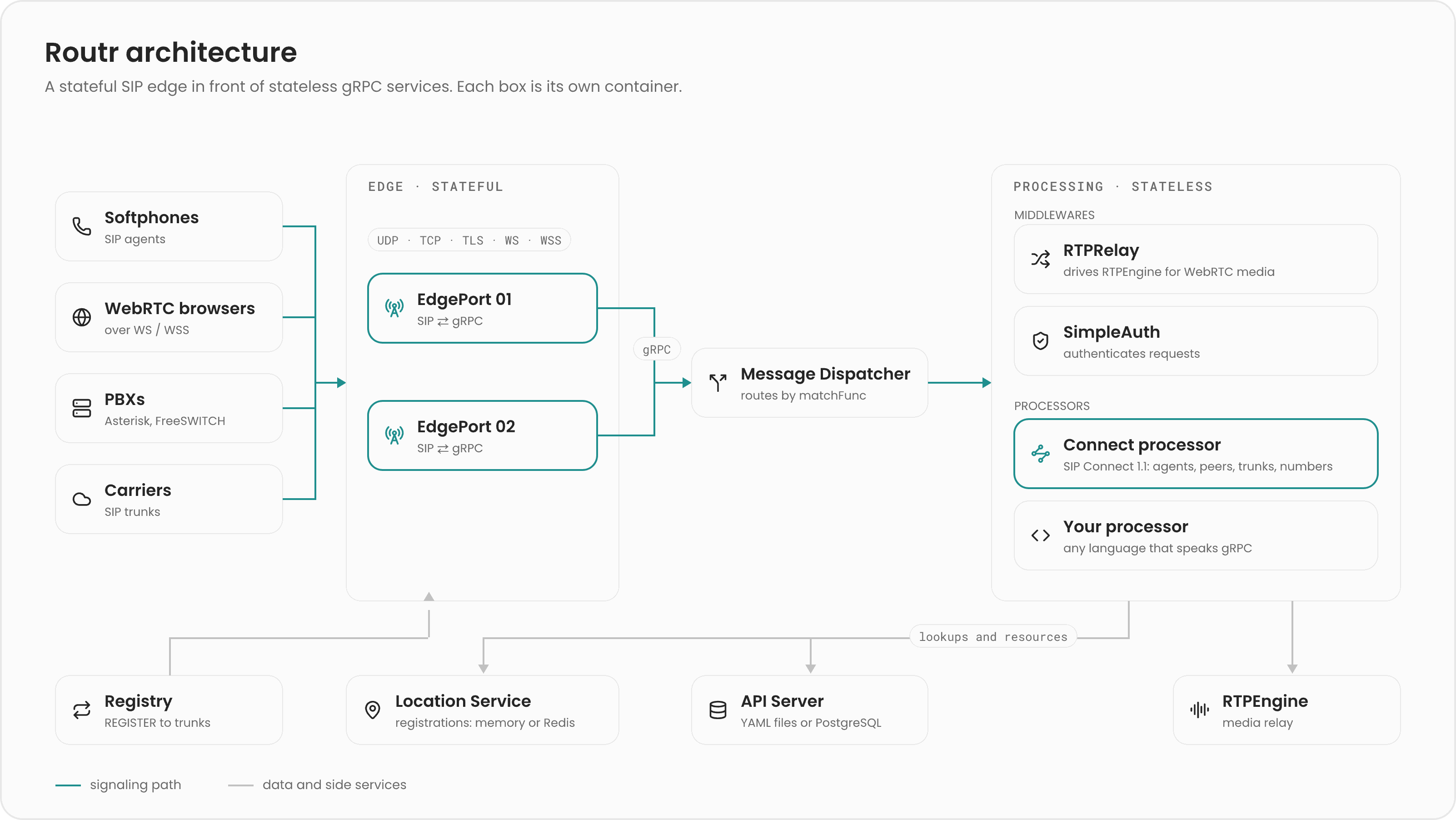
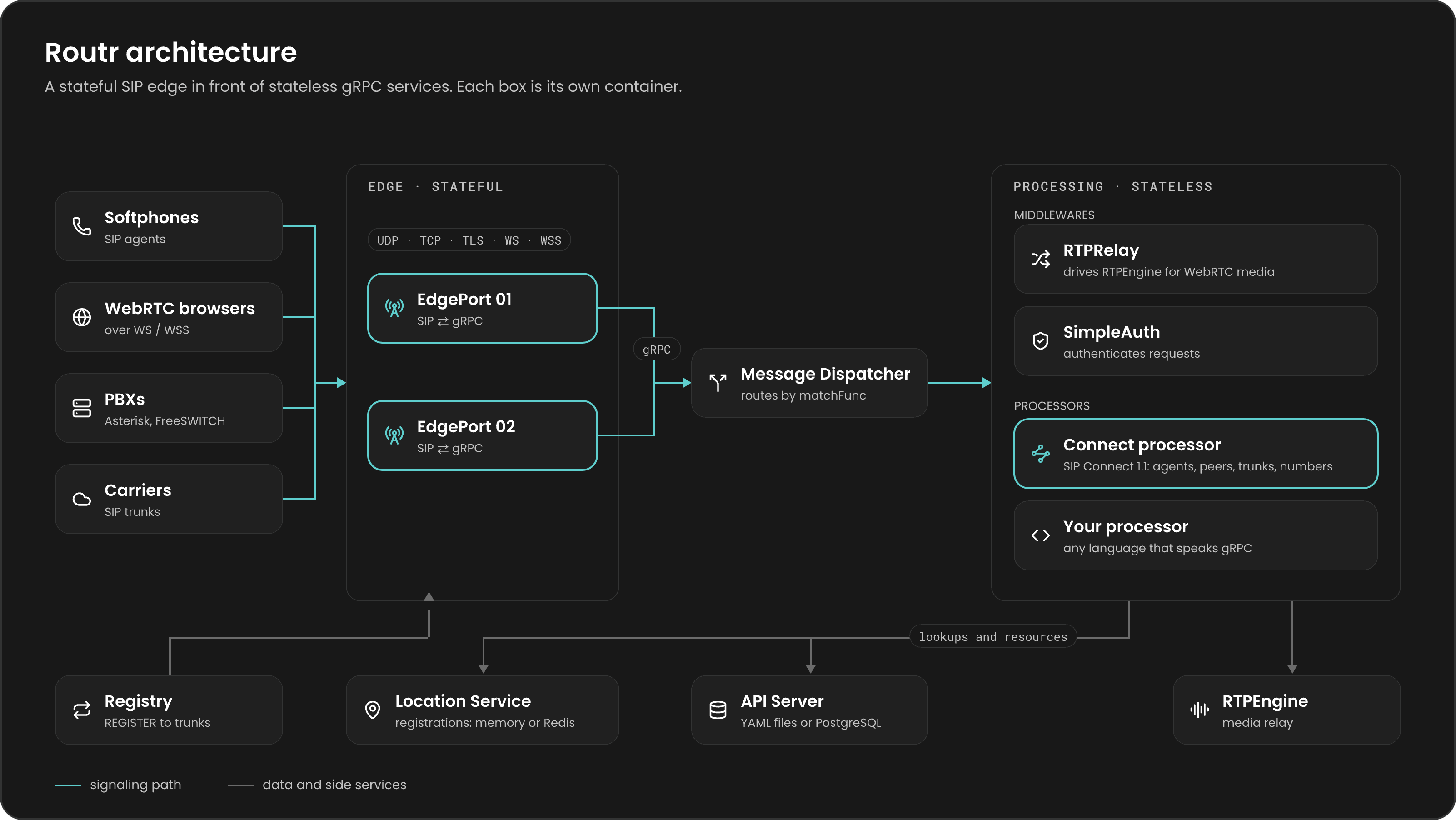
A traditional SIP server puts the network stack, the routing logic, and the data in the same process, and you program it with a configuration script. Routr separates them:- Only the edge speaks SIP. Everything behind it receives a protobuf message and returns one.
- Routing logic lives in a Processor, so you can write your own in any language with gRPC support.
- Each service scales on its own. If routing needs more CPU, you add Processor replicas, not more SIP edges.
fonoster/routr-one image runs all of them in one container so you don’t have to wire them together. See Deployment topologies.
Components
Core
These services make up the core of Routr, described in the Core specification.Connect mode and supporting services
Routr handles signaling only. Media flows directly between endpoints, or through RTPEngine when you use RTPRelay. To run IVRs, conferences, or voicemail, put Routr in front of a media server such as Asterisk or FreeSWITCH.
Stateful and stateless services
The EdgePort is the only stateful service. It keeps SIP transactions and the connections that clients opened to it, because SIP requires that a response goes back on the same transaction and, for TCP, TLS, and WebSocket, over the same connection. Losing an EdgePort loses the transactions and connections it held. Clients reconnect and re-register. The Message Dispatcher, Processors, and Middlewares are stateless. Every message they receive carries everything needed to process it: the SIP message plus metadata such as the EdgePort reference, its listening points, its external addresses, and its local networks. Any replica can handle any message, so you scale them horizontally behind a regular Kubernetes service. Data lives in two places outside the request path:- Registrations live in the Location Service. With the
memoryprovider, they exist only inside one Location instance. Useredisto share them across several instances. - Resources live behind the API Server, in YAML files or PostgreSQL.
Specifications
Routr’s behavior is written down in two draft specifications. You don’t need them to use Routr, but read them before you build your own Processor or replace a component.- Core specification (CORE.md): the EdgePort, Message Dispatcher, Processor, and Location Service, including their configuration and gRPC interfaces.
- Connect specification (CONNECT.md): the Connect processor, its resources, and its security rules.
Related pages
Message flow
Follow one request from the EdgePort to the Processor and back.
EdgePort cooperation
Learn how several EdgePorts route calls without a SIP load balancer.
Connect mode
See the resources the built-in Processor works with.
Deployment topologies
Choose between the all-in-one image and the Helm chart.